
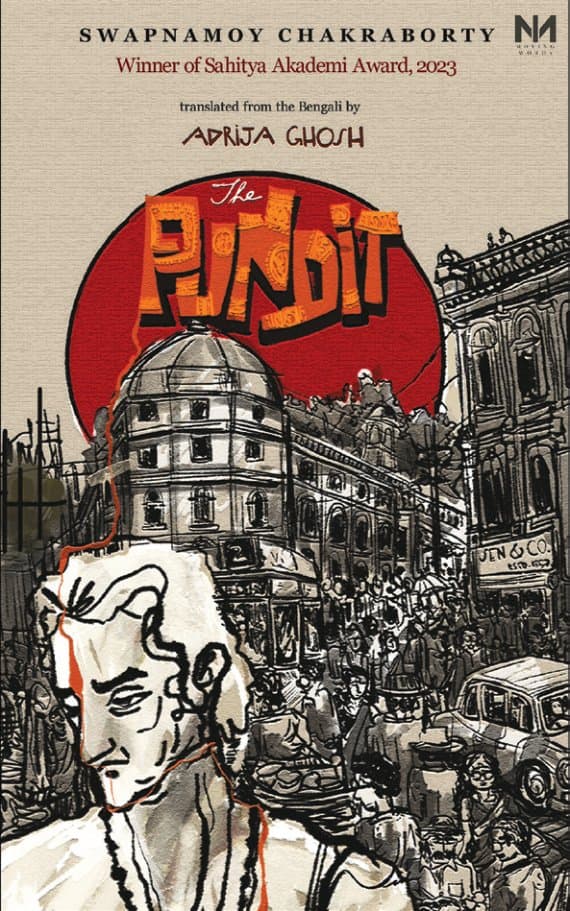
The Pundit
Swapnamoy Chakraborty
Translated by Adrija Ghosh
A boy blames himself for his father's death. Swapnamoy Chakraborty's The Pundit weaves caste, poverty, and faith into 1960s Bengal's fading world.
Full Synopsis
Set in post-independence Calcutta, The Pundit is a tender coming-of-age novel that explores caste, poverty, and faith through the eyes of Bilu, a Brahmin boy burdened by guilt over his father's death. The fading rituals of Brahmin honour, the quiet hunger of a household with no means, and the boy's watchful gaze bring alive a vanishing world. Chakraborty's prose captures both the intimacy of childhood and the broader disillusionment of a society caught between tradition and modernity.
Rights.aboutAuthorHeading
Swapnamoy Chakraborty is one of Bengal's most renowned literary voices. Winner of the Sahitya Akademi Award (2023) for Jaler Upar Pani and the Bankim Puraskar (2005) for Abantinagar, he has published over thirty novels and numerous short stories.
Excerpt
Anjali immediately rushed over, her voice sharp with urgency. “No,” she declared, “he will go to his father first.” Kamakhyacharan, his brows furrowed, regarded her with a mixture of surprise and disapproval. “His father? He will go to his father? What are you saying, Bouma?” “He will receive his father’s blessings first,” Anjali insisted, her voice firm. “In the mantra,” Kamakhyacharan countered, “there is no mention of blessings, Bouma. Only of begging, dear, of alms.” Anjali took Bilu’s hand and gently guided him to the wall. There, hanging in a frame, was a picture of his father. A blur of little beard and a slender frame, but it was the eyes—those distant, dreamy eyes—that caught Bilu’s attention. He had never seen his father like this, not in real life, with such a dreamy gaze, or with a smile so faint. This photo had been taken long before his wedding, back when his father had applied for a job. They had been unable to find any other photo of him at the time of his funeral. The only other photo Bilu’s mother had managed to pull out from an old envelope was of his father sitting in a chair, the pleated folds of his dhoti splayed lax across the floor. Beside him stood a small, round table with a flower vase. Bilu’s mother stood beside him too, her sleeves puffed up to her elbows, a mantilla (in proper terms called a veil) slightly covering her head. A faint smile curved her lips. Her aanchal, dotted with delicate polka, hung loosely around her, its folds relaxed and slack. A dot of vermilion rested on her forehead. One of her hands rested gently on the arm of his father’s chair, and his father’s hand, adorned with a ring, rested just shy of hers. But could such an image, of his mother’s aanchal so lax, really be displayed at a funeral? After thorough searching, his mother had finally found a yellowed envelope containing the worn-out photograph. It was this one that Biplob had framed and brought just before the funeral. On the wall, his deceased dad. The eyes…how distant, how dreamy they looked. A faint beard decorated his Baba’s face. Below the photo, it read: Studio Shatadal. Biplob folded his hands in reverence. Bhavan bhiksham dehi. But, this mantra would not work here. How could he beseech alms from a father who could no longer offer anything at all? “Beg for blessings, Bilu. Seek your father’s blessings,” Anjali said, placing her hand gently atop Biplob’s freshly shaved head. The newly shaven scalp tingled under her touch, a shiver ran through him. Bilu stood before the photograph. What blessings would he seek today? Before exams, his prayers had been simple, utilitarian: Baba, let me get good marks. May Asim not manage to beat me to it. During a nerve-wracking knockout football final, he had implored: Baba, please help me save a goal. Let no one dare to claim that our club lost due to its goalkeeper. But today, the stakes felt different. Was he to beseech and beg his father for divine intervention in the mundane restrictions of his new life? “Baba,” he might have whispered, “My sacred thread ceremony is complete. Now they won’t let me eat eggs for a year! They won’t let me eat onions! Bless me, so I don’t give in to temptation.” Or perhaps, “The evening mantras are so difficult, Baba. Bless me, so I can remember them all.” Taranath Smriti-Tirtha finally said, “Brahmachari, pray: O departed father, bless me that I may keep my mind fixed at the feet of the Lord and always remain a true and virtuous Brahmin.” But Bilu said none of it. Staying a true and virtuous Brahmin seemed like a colossal headache. He had seen his mother struggle, as well as the lengths she went to, so that his grandfather could adhere to those lofty ideals.