
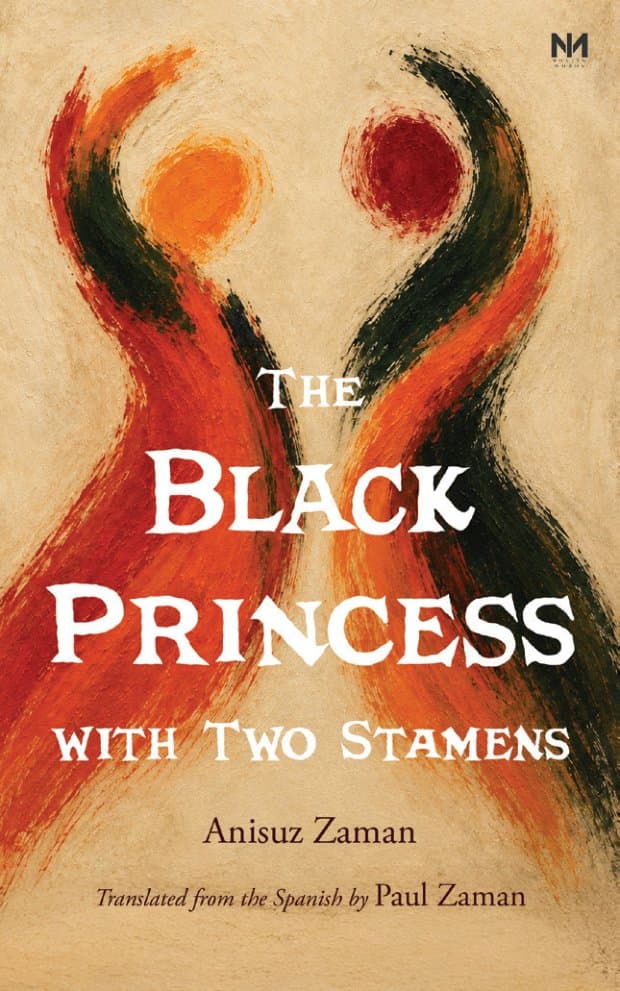
The Black Princess with Two Stamens
Anisuz Zaman
Translated by Paul Zaman
At her own funeral, Maria looks down at her corpse and starts talking back to it — an epic family saga narrated from beyond the grave, carrying readers from Etzatlán to Tijuana and back again.
Full Synopsis
At her own funeral, Maria looks down at her corpse — and starts talking back to it. So begins The Black Princess with Two Stamens, an epic family saga narrated from beyond the grave. As Maria tells her own story, she speaks to a chorus of others who crowd in: her mother, her brother, Librado, the father of her ten children, and the elusive Velazco — the mariachi who left roses at her door in silence, until the day she died. Together they build not just one woman's history, but the history of a family: its migrations, its inherited cycles of abuse, its losses, and its love, carrying readers from Etzatlán to Tijuana, across the border and back again. It is a novel of resistance on every level — in the story it dares to tell, in the grit of the people who live it, and in the quiet war fought inside Maria's own heart. In doing so, it reimagines what the epic family saga can be.
Rights.aboutAuthorHeading
Anisuz Zaman is a Bangladeshi writer, translator, and storyteller pioneering direct literary translation between Bengali and Spanish. He has translated major Bengali works into Spanish and brought renowned Spanish-American writers, including Gabriel García Márquez, Jorge Luis Borges, and Juan Rulfo, into Bengali. He is also the author of Princesa negra de dos estambres, a novel exploring memory, migration, and identity through a dialogue between Bengali and Latin American literary traditions.
Excerpt
It wouldn’t be unusual for us to crouch down for a quarter of an hour and watch trails of ants, a mountain frog, or a strange flower. We would sometimes lie down beside a waterfall, waiting for butterflies to appear or watching birds fly between the oak branches. Among the birds, I loved the hen harrier for its beautiful feathers and the woodpecker, even though they rarely showed up. I was also fascinated by the vultures gliding in the distance; they seemed to follow invisible paths. My father indulged my imagination, saying that these were special trails only visible to the birds. We would return home around noon, and after lunch, we’d share the fruits we had gathered—mangoes, plums, peaches, or guava with chili, salt, and lime, just as he liked it. As days passed, my father began to squander his money, giving little to my mother. He no longer took her to the plaza, and the tradition of our walks with tuberoses faded. His relationship with us, his children, also deteriorated. One by one, my siblings left home, except for the youngest, Chufo. On November 2, when I was nine, my father met a young woman visiting from Los Angeles for her grandmother’s Day of the Dead commemoration. The flowers she held reminded him of the tuberoses he once showered my mother with every Sunday. In the crowded cemetery, the festive atmosphere was reminiscent of the Friday market, filled with candles, flowers, and food on her grandmother’s grave. Later, my father hosted a dinner for the dead. Everything followed the town’s traditions. We gathered with both living family members and those who had passed away, sharing tamales, champurrado, mezcal, honey water for the young girls, pulque, and flan. We began with a prayer, and in whispers, the dead greeted each of us, assuring us they were well in Heaven. As the night wore on, we embraced our grandmother to say our goodbyes. Then, we danced. By three in the morning, everyone had fallen asleep. When my mother awoke, she couldn’t remember if she had gone to bed with my father. She searched for him, but to no avail. She would never see him again. I would never see him again. He had left, joining a mass exodus heading north, filled with those who depended on the mines. Etzatlán became a ghost town. Those few who remained in the plaza whispered that they had seen my father with a young woman carrying tuberoses, just like the ones he once gave my mother, though no one was certain.