
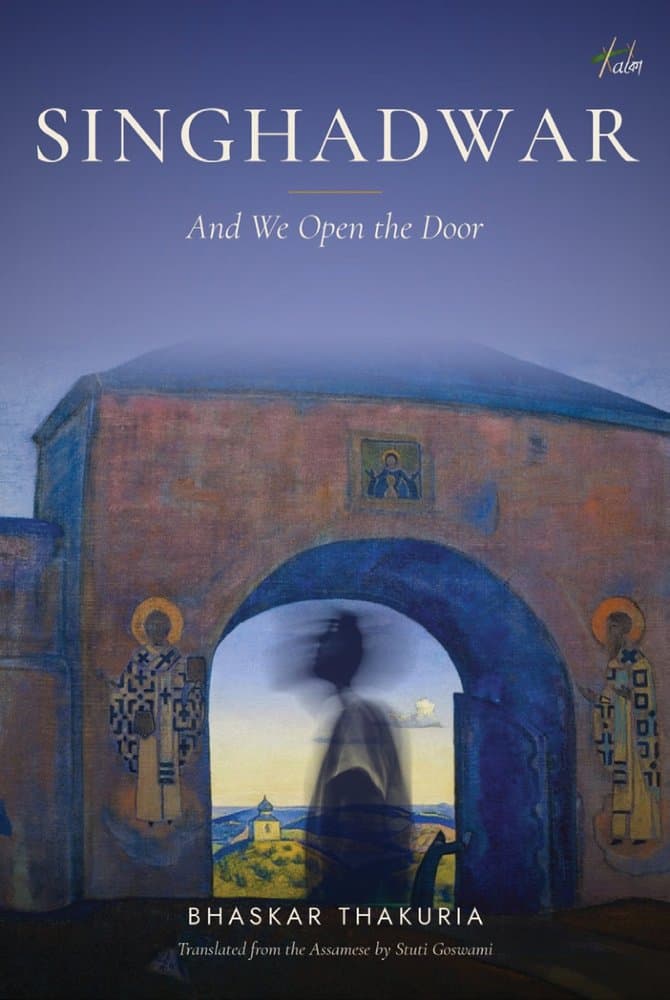
Singhadwar—And We Open the Door
Bhaskar Thakuria
Translated by Stuti Goswami
A polyphonic, multi-city novel of consciousness spanning three decades, following a gynaecologist, her psychiatrist husband, and a schizophrenic writer whose lives — and authorship of each other — remain uncertain.
Full Synopsis
Singhadwar—And We Opened the Door is a polyphonic, multi-city novel of consciousness, set across Guwahati, Delhi, Himachal Pradesh, and Puri, spanning roughly two to three decades from the 1990s to the 2000s. Its structure is extraordinary: it moves between three protagonists whose lives intersect through a mysterious schizophrenic writer named Aditya, who may or may not have created the other characters. Porinisha is a gynaecologist who cannot sleep, haunted by the faces of foetuses she has terminated and by a boy she watched die of a rare disease she correctly diagnosed but could not afford to treat. Chiranjeev is her psychiatrist husband, a man so controlled and precise he has forgotten how to feel. Aditya is a writer who abandoned language because he found it incapable of expressing truth, was hospitalised with schizophrenia, then spent twelve years as a vagabond across India — in search of nothing, which is his answer to everything. The novel is formally inventive in ways Indian literary fiction rarely is. It incorporates visual poetry with spatial typography, philosophical flow-charts, blog comment threads, email fragments, a psychiatric questionnaire, an art history lecture, Aditya's wordless scribbles, and five chapters structured around the senses (touch, sight, smell, taste, the sixth sense). The title comes from a Nicholas Roerich painting — We Are Opening the Gates (1922) — and the Assamese word Singhadwar (the lion gate, the grand threshold) is woven into the novel's final pages as Aditya finally opens the door to writing again after twenty years of silence.
Rights.aboutAuthorHeading
Bhaskar Thakuria is an academician and a medical microbiologist with a parallel, creative journey spanning over three decades. He debuted in the 90s in Guwahati's amateur theatre as a playwright and director while still a medical student. His subsequent venture as an experimental short-story writer earned him a space among thoughtful readers of Assam. His experiments with his creative tool have earned him long-standing followers in Assam and outside, as his stories have also been translated into a few regional Indian languages besides English.
Excerpt
1. The Night Shift That festive autumnal evening, when everything hung in stupor, the young man counted his final moments. His death could have been prevented. But then… The main road outside the hospital curved like a bow before the doctor’s window. On that road, Porinisha saw vehicles in a parade, the chaos of pipes and whistles blown by boys barely past puberty, and archways of halogen and litchi lights. […] Slowly dawn broke. The holy chants of the Goddess were blaring from the loudspeakers of a puja pandal nearby. The sweeper picked up his broom and began sweeping the hospital floors. Porinisha stretched her limbs and sipped black tea. An ambulance arrived to take the patient away. The people carried him onto the ambulance. (That same helpless gaze in his eyes.) “Thank you, Baideu.” Some of the patient’s guardians came to greet her. “Where have you decided to take him?” They had no answer. With a grating sound, the hospital gates opened, and the ambulance moved out. The morning rays of the autumnal sun swathed the hospital. Where did they take him, what happened to that patient afterwards? Porinisha was never to know. 2. The Malaise Ask not what it is… this malaise has no name, no cause, nor obvious symptom. […] His imaginary wireless device started gathering information. Not only from Birina, Miyah Abdullah, Rustom Jhunjhunwala, Asengla, and Piyush, but from Aditya the schizophrenic patient. — from that ever-unsmiling matron Smt. Shrivastav — from the bhang-inebriated gardener Ramcharan, who would steal flowers from the hospital garden to sell them elsewhere — the rickshaw-puller outside the hospital — the newly married couple seated on that rickshaw — the peanut seller — the pretty girl walking as if on the ramp with “Forget Me (K)Not” inscribed on her T-shirt It seemed that all of them and beyond, each inhabitant of this city, remained unfulfilled, directionless, and incomplete within. As if there was something in the wind. As if the times were such. A melancholy that slipped in with each breath. 3. Silver Valley (from “The Search”) That particular night was a full moon night. The snow-covered Himalayan peaks were glistening in the moonshine. Over the mountains there was the iridescence of a million stars, and below, the twinkle of a sea of fireflies. The crystal-clear waters of the Bipasha River reflected this sight on its wavy surface, the way one vaguely remembers last night’s dream in the morning. Cold winds swished through the rows of apple and pine trees. Aditya was immersed in the mesmerising beauty of the night. It seemed as if nature was covered in a cloak of silvery shimmer. Perhaps that’s why this valley is also called the Silver Valley, he mused. Just then there was a meteor shower. He wondered if he was dreaming.